Tag: health

  •  Breaking Free from the Trap of Comparison

     Breaking Free from the Trap of Comparison

    It is not easy to look at others and resist comparing ourselves. Social media has amplified this temptation beyond measure. With just a scroll, we are invited into curated glimpses of other people’s lives—glamorous vacations, sparkling new cars, dream homes, promotions, perfect family portraits, and endless celebrations. From the outside looking in, it feels as if everyone else is living a better life, as if they have figured out something we have not. The illusion is powerful, and it feeds into an unhealthy cycle of comparison and self-doubt.

    But for many of us, this comparison did not begin with social media—it started much earlier. I know because I grew up in an Asian household within a tight-knit Asian community. Comparison wasn’t just common; it was a way of life. Long before Facebook and Instagram existed, Asian moms had already created their own network of constant updates. They didn’t need an app; word of mouth spread quickly. Who bought the nicer car? Who moved into the better neighborhood? Who wore the more expensive outfit? These updates would pass through the grapevine like wildfire.

    It didn’t stop with material things. The real competition came with children. Whose kid got the highest grades? Whose kid got accepted into the better school? Whose child was more talented at piano, violin, or math competitions? The measuring stick was endless, and no matter how hard you tried, it always felt like someone else was one step ahead. It was exhausting. And when you grow up in that environment, you internalize it. The habit of comparison becomes second nature, shaping how you view yourself and your worth.

    As adults, this mindset doesn’t just go away. We carry it into our careers, our relationships, and our personal goals. If we are not careful, it becomes the lens through which we see everything. If we succeed, we downplay it because someone else has more. If we fail, we magnify it because it feels like proof that we are falling behind. And over time, this cycle doesn’t motivate us—it drains us.

    What I have learned, especially after becoming disabled, is that comparison is not only harmful, it is also meaningless. The gap between what I could once do and what others can do now feels enormous if I measure it by their achievements. If I looked at life that way, I would constantly feel like a failure. But here is the truth: envy is a sin, and comparison is a trap. The people we are comparing ourselves to are not thinking about us. They are not measuring themselves against us. They are too busy living their own lives. So why should we give them so much power over our own happiness?

    The only person worth comparing yourself to is yourself. Who were you yesterday, and who are you today? Did you grow, even in a small way? Did you take one step forward in your mindset, your habits, your patience, your kindness, your faith? These are the real markers of success. Improvement is not always about external accomplishments—it can be about becoming more resilient, more compassionate, or more grounded.

    This shift in perspective is not easy. It took me years to understand it, and it is still something I remind myself of daily. But once you break out of the cycle of comparison, you find freedom. You start to see that life is not a race and that your worth is not tied to how you measure up to others. You begin to appreciate your own path, no matter how different it looks from someone else’s.

    So here is the reminder: you are good enough. You do not need to prove your value by outshining someone else. Their story is not your story. Their timeline is not your timeline. As long as you keep improving, learning, and growing—even if only in small steps—you are moving in the right direction. And in that, you are already a winner.

  • When Life Reminds You Who’s Really in Control

    When Life Reminds You Who’s Really in Control

    It’s funny how some things in life feel like coincidences. Or maybe they’re not coincidences at all. Maybe life has a way of showing us exactly what we need to see, hear, or feel—right when we need it most.

    We see it in movies all the time. That magical incident that suddenly points someone to their true calling. And in real life, don’t we often ask for the same thing?
    “God, please give me a sign. Show me what I need to do, what I need to say, who I should marry.”

    And the crazy thing? The universe delivers. God delivers.

    This past Sunday, I walked into church carrying the heavy weight of my financial struggles—feeling like I had nowhere to run or hide. And wouldn’t you know it? The sermon was about living without control. About surrendering to God’s guidance because only He knows the path. Not a path free of pain, suffering, or hardship—but a path that leads us exactly where we’re meant to be.

    Maybe you’re not religious. That’s okay. Call it God, the universe, or just life—it still delivers signs. The question is: are you willing to listen?

    The answers we get aren’t always what we want. Often, the resistance we feel is because the truth runs directly against our desires. And yet, the lesson is the same: we don’t always get what we want in life.

    I teach this to my son all the time. No matter what social media influencers try to sell you or what the latest “manifest your destiny” book promises—you won’t get everything you want. Nobody does.

    Life has its balance. There will be pain, but there will also be joy. There will be suffering, but also freedom. God provides it all—the highs and the lows—because together, they shape us.

    So maybe the best move isn’t to fight for control but to let go. Let God, let the universe, let life take the driver’s seat. Because that’s how we eventually end up where we truly need to be.

  • When the Overwhelm Is Real: When You Need to Tap Out and Start Again

    When the Overwhelm Is Real: When You Need to Tap Out and Start Again

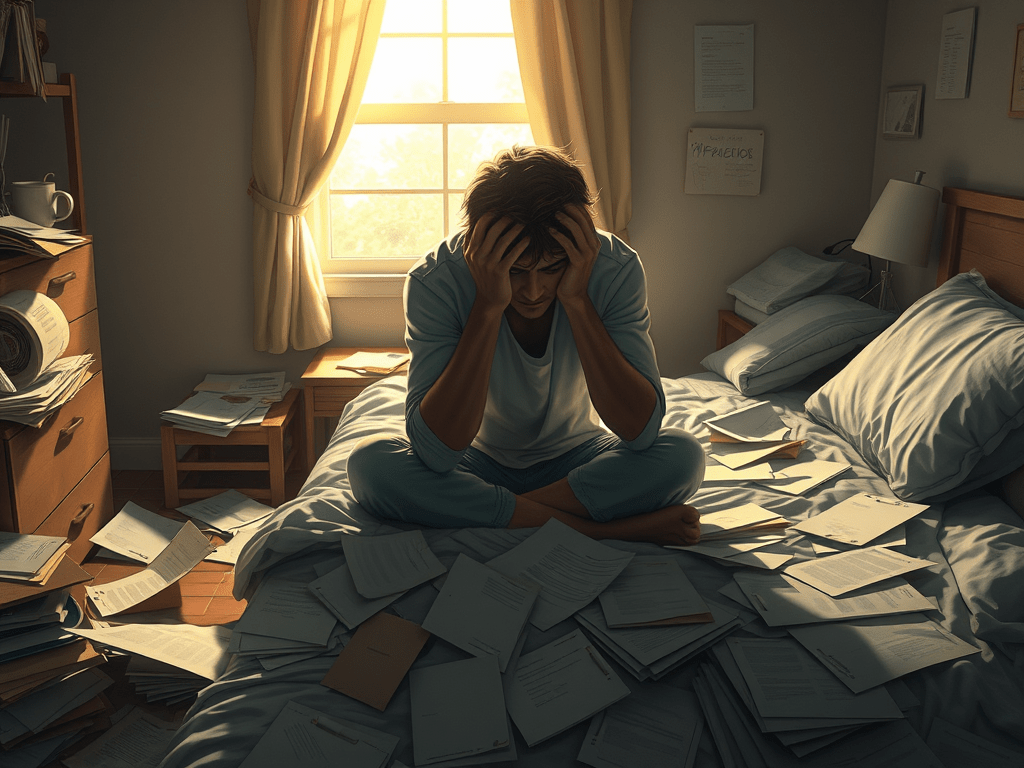
    What do you do when that overwhelming feeling isn’t just “I said yes to too many things” — it’s a full-on life crisis?

    Maybe you bought a house with a mortgage you can no longer afford because your job changed. Maybe you doubled down on a business or an investment and it went sideways — badly. Now the light at the end of the tunnel feels like a mirage. You can’t even take “one step at a time” because the path looks like a loose LEGO set with half the pieces missing.

    When the options really feel closed, sometimes the hardest and most practical choice is acceptance. Acceptance that something didn’t work out. Acceptance that you might need to take a loss. That could mean letting down a friend, disappointing your kids, or admitting to your church family that you’re struggling. Honesty in those moments is painful but also the best path forward — people usually respect the truth more than they respect perfection.

    There are situations where failure is on a bigger scale: a business that can’t be saved, a rental property that’s bleeding you dry, or a personal setback that feels insurmountable. I’m writing this while facing a couple of those exact realities. I know how paralyzing it is to stare at the paperwork and the what-ifs. I know the late nights and the churn of anxiety in your chest.

    Sometimes the most courageous move is to “tap out.” In jiu-jitsu, tapping means you accept the position and stop the fight so you can live to fight another day. It’s not surrender to weakness — it’s an intelligent decision to preserve your capacity for future battles.

    So what does “tapping out” look like in life?

    • It might mean closing a business and thinking through bankruptcy instead of sinking further.
    • It might mean selling a house at a loss to stop the monthly hemorrhage.
    • It might mean apologizing to people you’ve let down and explaining, honestly, what happened.

    There is no shame in choosing to stop the bleed. You’ll feel grief, disappointment, even failure — and you should. Those feelings are real and deserve space. But grief doesn’t have to be permanent. After the tap, you can rest, rebuild, and show up again.

    Ask yourself: do I want to go down with the ship, or do I want to survive and rebuild? Pride makes us want the heroic narrative where we push through and win against all odds. Reality sometimes says the heroic narrative is to cut losses, learn the lesson, and come back wiser.

    Remember: life isn’t fully under your control. There are storms, shifts, and forces beyond your plans. Letting go is not a moral failure — it’s often a strategic survival move. If this is your season to let go, do it with honesty, humility, and the intention to learn. Tap out. Breathe. And prepare to fight again — smarter, leaner, and stronger.

  • One Step at a Time: Beating Overwhelm, Setting Boundaries, and Moving Forward

    One Step at a Time: Beating Overwhelm, Setting Boundaries, and Moving Forward

    Ever get that overwhelming feeling that you’ve taken on more than you can chew? Same here. Often, it’s a false sense of insecurity whispering that we’re not ready. A new job. A competition we signed up for. Extra volunteer work. At the beginning, everything feels daunting—mostly because the task is 100% unfinished. Of course it feels huge.

    That’s when it helps to take a page from Brian Tracy’s Eat That Frog! The mindset is simple: take it one step at a time—one bite at a time.

    Sometimes we overload ourselves because we want to be liked. We want to be helpful. We want to be the “yes” person. I’m guilty of that too. Friends say, “Let’s go out,” and I say yes—even when my dining-out budget is already in the red. Church asks for volunteers and my hand shoots up—then my vision limitations make the role tough to execute. I sign my son up for multiple activities, then stress about how to get him to all of them.

    I pile things on my plate because I want to look like a good dad, a caring friend, a useful human. And then I end up on the couch, stressed about everything I promised to do. Not exactly a winning strategy.

    So how do we handle this? First, I sit myself down and remind myself: I can’t do everything—and that doesn’t make me a bad person. It’s okay to pass. It’s okay to say no. Sometimes, as I’ve learned in jiu-jitsu, the best defense is to avoid the bad position in the first place.

    If you do end up in a tough spot, tackle it step by step. The task is doable—you just need to break it down. Remember those LEGO sets from childhood? The massive ones looked impossible…until you opened the manual. Step 1, then Step 2, all the way to Step 1,000. It always starts with Step 1.

    When you feel overwhelmed because you agreed to everything, come back to basics:

    • Set a boundary and decline what doesn’t fit your season.
    • If you can delegate, do it—get the family involved.
    • Focus on the next small action, not the whole mountain.

    There is a light at the end of the tunnel. If you keep moving—one step at a time—you’ll get from Step 1 to Step 1,000. And yes, you can still be kind, helpful, and dependable—without saying yes to everything.

    Progress, not people-pleasing. Steps, not stress. That’s how we win this one.

  • Patience in a World of Instant Gratification

    Patience in a World of Instant Gratification

    Patience is one of the hardest things to find in modern society. With all these technological advances, we’ve gotten used to having everything at our fingertips. Food cooked in minutes, deliveries in less than an hour, and information at the speed of light. And now we even have AI fast-tracking nearly every part of our personal lives and society.

    But growing up, it wasn’t like this. I had to wait for everything. If I wanted to watch the next episode of my favorite show, I had to wait an entire week. If I needed something, I had to actually go out to the store. Every task seemed to take forever because the tools and shortcuts we take for granted today just didn’t exist.

    Now, I catch myself getting frustrated if something isn’t resolved instantly. My son does the same—he wants things at short notice, and he can’t even sit through an entire show anymore. He just skips from one YouTube short to the next, rarely finishing even half a video.

    And honestly, I can relate. I want my information fast. I lean on ChatGPT to speed up my research (yes, guilty as charged). I adjust the playback speed of videos and podcasts to the max just to save time. I even hesitate to order something online if it’s going to take longer than two days—thank you, Amazon Prime, for spoiling us.

    But deep down, I know this isn’t how life is supposed to be. Growth takes time. Real transformation—whether it’s reinventing yourself, developing your mindset, or building character—doesn’t happen overnight. It’s not a quick delivery. It’s a lifelong journey.

    So when you feel yourself wanting to fast-forward to the finish line, slow your mind down. Take a breath. Watch Adam Sandler’s movie Click if you need a reminder of what happens when you rush through life. (Spoiler alert: it doesn’t end well.)

    There’s truth in that old saying: “Stop and smell the roses.” The journey itself is what shapes you. The experiences, the waiting, the little struggles—they’re what make the victories sweeter.

    Patience may feel like an outdated virtue in a world of instant gratification, but it’s still one of the most powerful lessons we can learn. Slow down, enjoy the process, and remember: the best things in life rarely come with same-day delivery.